
- News
"Positioning PSL at the forefront of the digital revolution in chemistry"
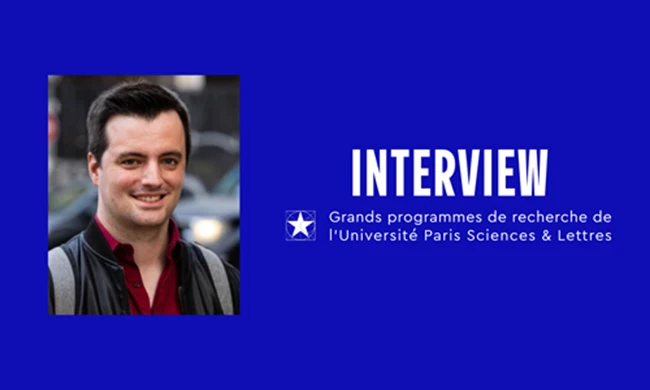
Interview with Thijs Stuyver, researcher in digital chemistry at Chimie ParisTech - PSL, holder of the PR[AI]RIE-PSAI Chair, and co-leader of the ChemAI Major Program (Chemistry informed models: Artificial Intelligence for Chemistry).
To begin simply: what is the ChemAI program, and why is it important for the future of chemistry?
ChemAI starts from a simple observation: every day, laboratories produce an enormous amount of chemical data, yet only a fraction of it ever gets published – and usually only the “success stories.” Negative results, which are often just as informative, tend to disappear. On top of that, data is rarely recorded in a standardized way, which makes it difficult to exploit with artificial intelligence.
One of ChemAI’s main ambitions is therefore cultural: to better organize, share, and valorize all kinds of chemical data, so that it can truly be harnessed by AI models. But that’s only half the picture. In parallel, we are developing AI tools designed specifically for chemistry – capable of predicting properties, suggesting new experiments, and optimizing complex processes.
By combining these two elements – high-quality data and advanced AI methods – ChemAI aims to concretely accelerate the discovery of new molecules, innovative materials, and more sustainable reactions, while positioning PSL at the forefront of the digital revolution in chemistry.
Artificial intelligence is already used to analyze large datasets in many fields. What breakthroughs can it bring to chemistry that traditional methods could not achieve?
Chemistry is, by nature, combinatorial. There are countless ways of combining atoms and molecules to create new substances and materials. And every experimental procedure comes with a vast array of parameters – temperature, solvents, catalysts, reaction time, synthesis conditions – multiplying the possibilities even further. This creates research spaces so vast that no human intuition alone can explore them systematically.
This is where AI changes the game. It allows us to navigate these oceans of possibilities in a rational, data-driven way. For example, it can dramatically speed up reaction optimization by identifying the most efficient conditions among thousands of combinations. It can guide the design of entirely new materials – for photovoltaics, energy storage, or catalysis – by predicting their properties before they are ever synthesized. And it can shed new light on complex phenomena, from the behavior of living cells to the real-time dynamics of chemical reactions.
In short, AI doesn’t replace the creativity and vision of the chemist, but it amplifies them. It can propose unexpected solutions while taking over the laborious work of exploration and optimization that is so central to chemistry.
This program also emphasizes training the next generation. In your view, what will the chemist’s job look like in ten or twenty years with these new tools?
We are already witnessing a profound transformation across cutting-edge laboratories: experiments are increasingly automated, with robots capable of running hundreds of tests in parallel, and research decisions rely more and more on large-scale data analysis. This trend is only going to spread over the next decades, reshaping the everyday practice of chemistry.
The chemist of the future will therefore need to work hand in hand with these technologies. Instead of spending most of their time manipulating samples at the bench, they will design and orchestrate large-scale experimental campaigns, interpret the results with the help of AI, and integrate data-science skills into their daily practice. In other words, the profession is evolving toward a close collaboration between human and machine – the researcher’s creativity and vision reinforced by the power of automation and artificial intelligence.
Bonus question: how can ChemAI contribute to tackling major challenges such as the energy transition, pollution, or drug discovery?
The great challenges of our time – developing sustainable energy sources, fighting pollution, discovering new medicines – demand fast solutions. Yet chemical research is traditionally slow and complex: each new molecule or material can take years of trial and error.
With ChemAI, we want to accelerate this process. By improving how data is collected and shared, and by using AI models to guide experimental choices, we can make more effective decisions and focus our efforts where the chances of success are highest. That means faster progress in developing materials to capture CO₂, optimizing greener chemical processes, or identifying promising therapeutic molecules.
In short, ChemAI is about changing the speed of progress in chemistry – so that research can respond more rapidly and more effectively to society’s most pressing needs.